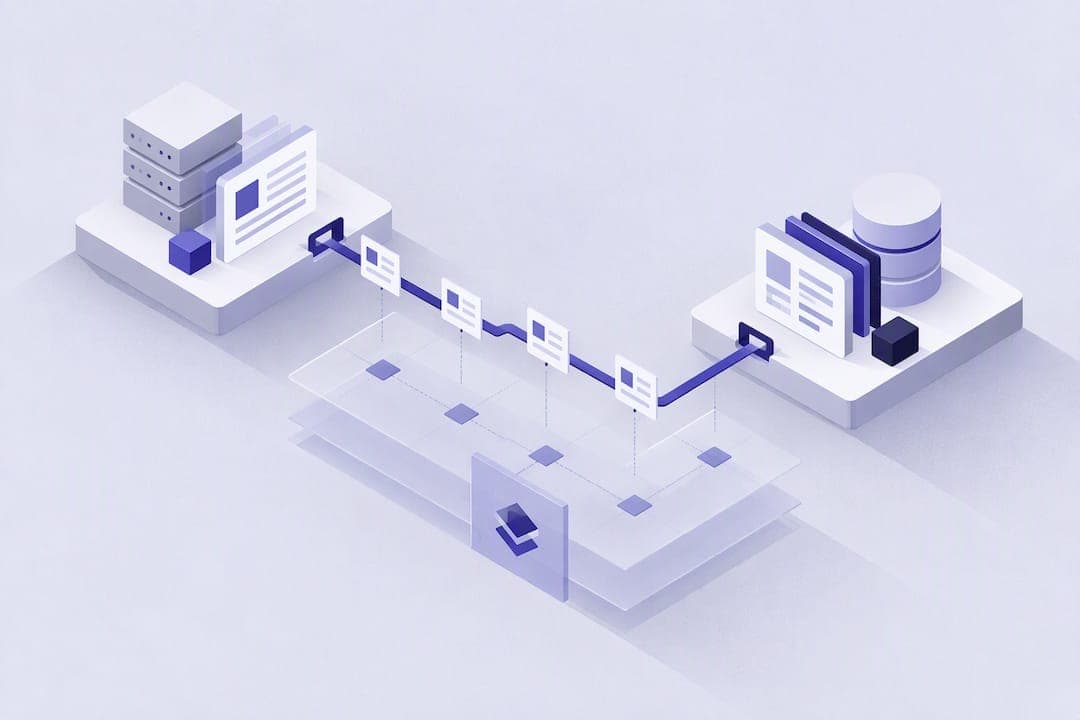
An EDC captures participant clinical data through eCRFs and produces the dataset used for analysis, while a CTMS manages trial operations such as sites, visits, and budgets. EDC users are typically site coordinators and data managers; CTMS users are typically clinical operations and monitoring teams. The two systems complement each other and, in most trials, need to be integrated to support auditability.
TL;DR:
- Integrating CTMS and EDC ensures consistent data and operational tracking across multiple sites, reducing manual entry errors and rework.
- A typical trial with more than one site or complex monitoring requires both systems to be connected for real-time progress and compliance visibility.
- Validation of systems must include thorough audit trails capturing user identity, change timestamp, and before-and-after values, retained for inspection readiness.
- Data origin, such as from electronic health records or wearable devices, must be recorded in the EDC, with metadata indicating visit timing and visit status in CTMS.
- Vendors should be asked about validation processes, standards supported, data synchronization latency, and secure credential management before integration.
Table of Contents
- What is EDC and what records does it hold?
- What is CTMS and what operational records does it manage?
- Side-by-side mapping: who owns which records and why
- Integration benefits and practical data mapping steps
- Regulatory and inspection implications for audit trails and validation
- Deciding whether you need EDC alone or both systems
- Implementation checklist and questions to ask vendors
- How CTMS and EDC systems developed over time
- Common pitfalls when CTMS and EDC are not connected properly
- Examples of platforms in the CTMS and EDC market
- How these systems affect trial timelines and efficiency
- Security considerations beyond regulatory compliance
- How Talentro helps with CTMS and EDC integration and compliance projects
- Sources
- FAQ
What is EDC and what records does it hold?
Electronic Data Capture (EDC) is the software where sites enter participant-level clinical data through electronic case report forms, or eCRFs. Each field on an eCRF corresponds to a data point a protocol requires, and the system is built to catch errors before they reach the analysis dataset.
Core EDC features include:
- Edit checks that flag out-of-range or inconsistent values as they are entered.
- Query management workflows that let data managers ask sites to clarify or correct entries.
- Export formats aligned with CDISC standards, which support downstream statistical analysis.
- An audit trail that records every change made to a data point.
- Database lock functions that freeze the dataset once cleaning is complete.
Records that belong in EDC include lab results, vital signs, adverse event and serious adverse event reports, and primary or secondary endpoint data. For a single-site, low-complexity study, particularly an exploratory or early-phase trial with a small dataset and minimal monitoring burden, an EDC alone can be sufficient. Once a trial adds sites, complex monitoring, or vendor coordination, that changes.
What is CTMS and what operational records does it manage?
A Clinical Trial Management System (CTMS) functions as the operational command center for a trial. Where EDC answers "what did the patient report," CTMS answers "is the trial running on schedule and within budget." According to CASRAI's description of CTMS, CTMS tracks operations such as sites, enrollment, and monitoring visits, while EDC handles the clinical values themselves. They answer different questions for operational management versus data readiness.
Core CTMS features include:
- Site management tools covering site selection, activation, and contact tracking.
- Enrollment tracking dashboards that show recruitment progress against targets.
- Monitoring visit scheduling and trip report logging.
- Budget and payment tracking tied to site milestones.
- Regulatory document tracking, including essential documents and their expiration dates.
Records owned by CTMS include site activation dates, monitoring visit reports, and payment logs. Teams running a very small, single-site study with minimal budget complexity can sometimes delay CTMS adoption, tracking sites and payments in spreadsheets instead. That approach stops scaling once a second or third site joins.
Side-by-side mapping: who owns which records and why
Deciding which system is the source of truth for a given record type avoids duplicate entry and conflicting values during an inspection.
Edge cases complicate this split. Data captured through eSource or digital health technologies (DHT) often needs to enter the EDC directly, and the FDA's guidance on computerized systems used in clinical trials notes that when data originate outside the sponsor's own systems, such as from an EHR or a wearable device, the data originator, timestamp, and relevant metadata must be recorded once that data enters the EDC. Visit-level metadata, such as whether a visit occurred on schedule, often belongs in CTMS even though the clinical content of that visit lives in EDC.

Pro Tip: Pick one system as the canonical source for each data element before go-live, and document that decision in your data management plan so nobody re-enters the same value twice.
Integration benefits and practical data mapping steps
Syncing CTMS and EDC removes manual re-entry and keeps operational dashboards aligned with actual clinical progress. The points worth syncing are consistent across most trials:
- Subject IDs, so the same participant is recognized across both systems.
- Visit status, so CTMS monitoring schedules reflect what actually happened in EDC.
- Enrollment counts, so recruitment dashboards do not lag behind site entries.
- Query counts, so operations teams can see where data cleaning is falling behind.
- Monitoring visit completion, so site payment triggers fire accurately.
Teams typically use CDISC ODM as a metadata exchange standard, or vendor-supplied REST APIs and webhooks for near-real-time updates. ODM is well suited to structured, batch-style transfers; APIs and webhooks suit trials that need faster updates but require more engineering to maintain.
Common pitfalls include ID collisions when subject or site identifiers are formatted differently between systems, latency between when data enters EDC and when it appears in CTMS, and duplicate records created when both systems allow manual entry of the same field. Mapping canonical keys, subject ID, site ID, and visit code, before development begins prevents most of these problems. Successful integration projects typically involve a dedicated data manager, an integration engineer, and a clinical operations lead who signs off on the mapping logic.
Regulatory and inspection implications for audit trails and validation
ICH E6(R3) requires that computerized systems used in a trial be fit for purpose and validated based on risk, with validation depth matched to how critical the system is to participant safety and data integrity.
Audit trails must capture the date and time of a change, the identity and role of the user who made it, and both the old and new values. These three elements are required for computerized systems used in clinical trials under ICH and FDA expectations, and the audit trail must be searchable and retained for as long as the record itself.

FDA's guidance on computerized systems clarifies that Part 11 applicability depends on when data enters the sponsor's own systems, and that EDC platforms will be evaluated for Part 11 compliance during inspection rather than pre-approved beforehand. Inspectors expect EDC to produce clinical data provenance and CTMS to produce operational governance evidence, such as monitoring history and document tracking; missing either weakens an inspection response.
Deciding whether you need EDC alone or both systems
Trial scale and complexity drive this decision more than budget alone.
- EDC alone is often defensible for single-site, low-complexity, or exploratory studies with minimal monitoring overhead.
- Multi-site trials, complex monitoring plans, decentralized elements, or heavy vendor coordination generally require CTMS.
- A trial adding a second site, a central monitoring vendor, or DHT-based data collection has usually crossed the threshold where CTMS earns its cost.
- Budget and payment complexity across multiple sites is a strong signal that spreadsheet-based tracking will not hold up.
Whichever path a team chooses, planning the CTMS-EDC integration early, before database build, rather than retrofitting it after go-live, avoids the ID mapping and reconciliation problems described above.
Implementation checklist and questions to ask vendors
Before development starts, map canonical entities (subject ID, site ID, visit code), decide which system owns each data element, and define the scope of user acceptance testing (UAT).
- Ask vendors how they validate their system and what documentation they provide to support your own risk-based validation.
- Ask whether audit-trail data can be exported in a format your quality team can review independently.
- Ask which standards (CDISC ODM, REST API) the integration supports and what the data-sync latency is.
- Build milestones around mapping sign-off, test script execution, go-live cutover, and a reconciliation check afterward.
Include acceptance tests that reproduce an inspection scenario directly in the contract, such as demonstrating who changed a specific value, when, and why, retrieved from the audit trail on demand.
Pro Tip: Request a sample audit-trail export during vendor evaluation, before signing, so your quality team can confirm it is genuinely searchable and not just a static log file.
How CTMS and EDC systems developed over time
Clinical trial data management began with paper case report forms shipped between sites and sponsors, a process that made query resolution slow and audit trails effectively nonexistent. EDC systems emerged to replace that paper workflow with browser-based data entry, and adoption accelerated through the 2000s as sponsors sought faster database lock timelines and built-in edit checks that paper forms could never provide.
CTMS evolved on a separate track, growing out of the operational need to track increasingly complex, multi-site, multi-country trials. Early CTMS tools were often little more than shared spreadsheets or site-tracking databases; over time they absorbed enrollment forecasting, monitoring visit scheduling, and financial tracking as trials grew in scale and regulatory documentation requirements expanded.
For years, the two systems developed independently because they served different departments: data management owned EDC, while clinical operations owned CTMS. That separation made sense organizationally but created a practical problem as trials grew more complex: operational milestones tracked in CTMS, like enrollment counts, and clinical data entered in EDC often told slightly different stories because nobody had connected them. The rise of multi-site, multi-vendor, and increasingly decentralized trial designs pushed integration from a convenience into something closer to an operational necessity, since sponsors now need both systems to reflect the same trial reality in real time to avoid conflicting reports during monitoring visits or inspections.
Common pitfalls when CTMS and EDC are not connected properly
The most frequent problem is treating EDC as if it were a CTMS module rather than a separate system with a separate user base. This misconception leads teams to try to track enrollment or site budgets inside EDC, which the system was never built to do well, or to skip CTMS entirely and lose visibility into monitoring compliance.
When the two systems run without integration, manual re-entry becomes the default way to keep dashboards current. A data manager updates EDC, then someone manually updates enrollment counts or visit status in CTMS, and the two inevitably drift out of sync. This creates real inspection risk: regulators expect sponsors to produce both clinical observations from EDC and governance evidence from CTMS, and a mismatch between the two, such as a monitoring visit report referencing a visit that EDC shows never happened, invites scrutiny.
Duplicate records are another common pitfall, particularly when both systems allow manual entry of the same field, such as visit dates. Without a clear rule for which system's value wins in a conflict, reconciliation becomes a manual, error-prone exercise during database lock.
Underestimating the integration effort itself is perhaps the most consistent mistake. Mapping subject IDs, site IDs, and visit codes across two systems built by different vendors is rarely trivial, and projects that treat it as a quick technical task rather than one requiring dedicated data management and integration engineering resources tend to run into delays close to database lock, when there is little time left to fix them.
Examples of platforms in the CTMS and EDC market
The EDC market includes platforms built specifically for eCRF-based data capture, with strengths generally centered on edit-check flexibility, CDISC-compliant exports, and query management workflows. Medidata Rave is widely recognized in the industry primarily as an EDC platform, built around capturing and cleaning participant-level clinical data rather than managing site operations or budgets.
CTMS platforms are built around the opposite priority: operational visibility across sites, enrollment, and monitoring rather than clinical data capture. Veeva offers products across both categories, including an eTMF (electronic trial master file) offering for regulatory document management, which is a distinct function from either CTMS or EDC, since eTMF specifically manages the essential documents required to reconstruct trial conduct rather than clinical data or day-to-day site operations.
Some vendors offer suites that bundle CTMS, EDC, and eTMF functionality under one contract, which can simplify procurement and reduce integration work, at the cost of being locked into one vendor's roadmap for all three functions. Others specialize in a single layer and rely on integration to connect with a sponsor's chosen tools in the other categories, which offers more flexibility in choosing the strongest tool for each function but shifts the integration burden onto the sponsor's team. Neither approach is universally better: the right choice depends on trial complexity, existing vendor relationships, and how much integration engineering capacity a sponsor has in-house.
How these systems affect trial timelines and efficiency
EDC's edit checks and query management workflows are designed to catch data problems early, which shortens the time between last patient visit and database lock, since fewer queries remain open when data collection ends. Database lock timelines depend heavily on how quickly queries are resolved during the trial rather than at its close, which is a direct function of how well EDC edit checks are configured from the start.
CTMS efficiency gains show up differently, primarily in monitoring and enrollment management. Real-time enrollment dashboards let operations teams catch underperforming sites early enough to add recruitment support or additional sites before a delay compounds. Monitoring visit scheduling tools reduce the administrative overhead of coordinating site visits across a large, multi-country trial.
When the two systems are integrated, the efficiency gain compounds: operations teams can see enrollment and query volume side by side, which helps them decide whether a lagging site needs a monitoring visit or a data management intervention. Without integration, teams often discover data quality problems only when a stalled query count in EDC does not get flagged in the CTMS dashboards that leadership actually reviews, delaying the intervention.
Security considerations beyond regulatory compliance
Beyond meeting audit-trail and validation requirements, CTMS and EDC systems handle sensitive data that requires practical security controls independent of the compliance checklist. EDC holds participant-level clinical data, including adverse event narratives that can contain identifiable health information, which makes role-based access control essential: a site coordinator should not be able to see data entered by another site, and a sponsor's data manager should not have unrestricted access to unblinded treatment assignments in a blinded trial.
CTMS holds a different kind of sensitive data: site payment amounts, contract terms, and monitor contact information, all of which carry business confidentiality concerns even though they are not clinical data. Access controls in CTMS need to reflect organizational roles, limiting budget visibility to finance and operations leads rather than every user with system access.
Integration points between the two systems introduce their own security surface. Data flowing through an API or webhook needs to be encrypted in transit, and the integration layer itself needs its own access logging, since a compromised integration credential could expose data from both systems simultaneously. Teams building or buying an integration should ask specifically how credentials are managed and rotated, not just whether the data is encrypted.

How Talentro helps with CTMS and EDC integration and compliance projects
Mapping subject IDs across systems, writing validation protocols, and preparing audit-trail exports for inspection all require specific expertise that most internal teams do not have on staff full-time. A specialized service sources, screens, and coordinates European domain experts for these kinds of defined projects, including clinical data management, systems validation, and regulatory documentation work.

A project brief works best when it specifies:
- The expertise needed, such as CDISC ODM mapping experience or GCP audit-trail validation.
- The number of specialists and the expected engagement length.
- Location and language requirements for the project.
- Timeline and budget so Talentro can check specialist availability accordingly.
Submit a project brief through the EU AI Expert Network with these details, and the service will coordinate sourcing and screening against your requirements.
Sources
- ICH E6(R3) consolidated guideline (2026)
- FDA guidance: Computerized systems used in clinical trials
- Clinical Trial Management System (CTMS): What It Is and Does — CASRAI
FAQ
What is CTMS and EDC in clinical research?
CTMS is software that manages trial operations, including sites, enrollment, monitoring, and budgets. EDC is the system where sites enter participant clinical data through eCRFs, producing the dataset used for analysis.
What is the difference between CRF and EDC?
A CRF, or case report form, is the document or form structure that defines what data a protocol requires; an eCRF is its electronic version. EDC is the software platform where those eCRFs are built, completed, and stored, including the edit checks and audit trail around them.
Is Medidata Rave a CTMS?
No, Medidata Rave is widely recognized in the industry as an EDC platform built for capturing and cleaning participant-level clinical data rather than managing trial operations. Operational functions like enrollment tracking and site budgets belong to a separate CTMS.
Is Veeva a CTMS?
Veeva offers products across multiple categories, including an eTMF offering for managing regulatory documents, which is a distinct function from CTMS or EDC. Whether a specific Veeva product functions as a CTMS depends on which product line a sponsor has deployed, so it is worth confirming directly with the vendor for a given contract.
When is an EDC-alone setup enough without a CTMS?
An EDC-alone setup is often defensible for single-site, low-complexity, or exploratory studies with minimal monitoring and budget tracking needs. Once a trial adds a second site, complex monitoring, or decentralized data sources, a CTMS typically becomes necessary to keep operations visible.